O3seespy Documentation
This is the official documentation of the O3seespy (or simply O3) package.
O3seespy - Object-oriented OpenSees in Python
The documentation is built off the OpenSees tcl and OpenSeesPy documentation and has been amended and added to to cover the additional functionality of the O3seespy package.
The main difference between O3seespy and OpenSeesPy is that O3seespy provides a pure python layer to evaluate OpenSees inputs. This improves debugging and allows parameters to be easily accessed within Python.
Contents
- Installation
- Commands directory
- o3seespy.OpenSeesInstance
- Common commands
AlternativeAnalysisEleLoad2DPointEleLoad2DUniformEqualDOFEqualDOFMultiFixFix1DOFFix1DOFMultiFix2DOFFix2DOFMultiFix3DOFFix3DOFMultiFix4DOFFix6DOFFix6DOFMultiImposedMotionLoadMassMass2DMass3DModalDampingParameterRigidLinkSPadd_fixity_to_dof()analyze()analyze_w_restart()domain_change()gen_reactions()get_all_ele_node_tags()get_all_ele_node_tags_as_dict()get_all_ele_node_tags_by_n_nodes()get_all_node_coords()get_all_node_coords_w_tag()get_all_node_disps()get_eigen()get_ele_response()get_ele_tags()get_node_accel()get_node_coords()get_node_disp()get_node_disps()get_node_dofs()get_node_eigen_vector()get_node_pressure()get_node_reaction()get_node_reactions()get_node_tags()get_node_unbalance()get_node_vel()get_np()get_num_threads()get_pid()get_time()imposed_motion()load_constant()loop_for_analyze_w_restart()record()remesh()remove()remove_load_pattern()remove_recorders()remove_sp()reset()set_ele_rayleigh_damp()set_element_rayleigh_damping_factors()set_equal_dof()set_equal_dofs()set_equal_dofs_mixed()set_node_mass()set_num_threads()set_parameter()set_rigid_diaphragm()set_rigid_link()set_time()start()stop()update_element_domain()update_material_stage()update_parameter()wipe()wipe_analysis()
- o3seespy.algorithm
- o3seespy.analysis
- o3seespy.beam_integration
- o3seespy.constraints
- o3seespy.element
- Base element
- Beam-column
- Bearing
ElastomericBearingBoucWen2DElastomericBearingBoucWen3DElastomericBearingPlasticity2DElastomericBearingPlasticity3DElastomericXFPBearingPTVFlatSliderBearing2DFlatSliderBearing3DHDRKikuchiBearingadjustPDOutputKikuchiBearingdoBalanceLeadRubberXMultipleShearSpringRJWatsonEqsBearing2DRJWatsonEqsBearing3DSingleFPBearing2DSingleFPBearing3DTFPTripleFrictionPendulumYamamotoBiaxialHDRcoRS
- Brick
- Cable
- Contact
- Joint
- Link
- Misc
- Other UP
- PFEM
- quadrilateral
- Soil-foundation
- Tetrahedron
- Triangular
- Truss
- UC San Diego UP
- Zero length
- o3seespy.geom_transf
- o3seespy.integrator
- o3seespy.node
- o3seespy.nd_material
- base_material
- concrete_walls
- contact
- other_material
- Standard
AcousticMediumBoundingCamClayDamage2pDruckerPragerDruckerPrager.denDruckerPrager.nuDruckerPrager.op_typeDruckerPrager.set_bulk_mod()DruckerPrager.set_cohesive_intercept()DruckerPrager.set_frictional_strength()DruckerPrager.set_g_mod()DruckerPrager.set_material_state()DruckerPrager.set_nonassociative_term()DruckerPrager.set_nu()DruckerPrager.set_update_material_stage()DruckerPrager.update_eles_to_linear()DruckerPrager.update_eles_to_nonlinear()
ElasticIsotropicElasticOrthotropicElasticOrthotropic.op_typeElasticOrthotropic.set_e_mod_x()ElasticOrthotropic.set_e_mod_y()ElasticOrthotropic.set_e_mod_z()ElasticOrthotropic.set_g_mod_xz()ElasticOrthotropic.set_g_mod_yx()ElasticOrthotropic.set_g_mod_zy()ElasticOrthotropic.set_rho()ElasticOrthotropic.set_vxz()ElasticOrthotropic.set_vyx()ElasticOrthotropic.set_vzy()
FSAMJ2PlasticityManzariDafaliasManzariDafalias.op_typeManzariDafalias.set_integration_scheme()ManzariDafalias.set_jacobian()ManzariDafalias.set_material_state()ManzariDafalias.set_nu()ManzariDafalias.set_ref_shear_modulus()ManzariDafalias.set_stress_correction()ManzariDafalias.set_update_material_stage()ManzariDafalias.set_void_ratio()ManzariDafalias.update_to_linear()ManzariDafalias.update_to_nonlinear()
MultiaxialCyclicPlasticityPM4SiltPlaneStrainPlaneStressPlateFiberStressDensity
- Tsinghua_sand
- UC San Diego soil
- UC San Diego UD soil
- Wrapper
- o3seespy.node
- o3seespy.numberer
- o3seespy.patch
- o3seespy.pattern
- o3seespy.rayleigh
- o3seespy.recorder
ElementToArrayCacheElementToFileElementToXMLElementsToArrayCacheElementsToFileElementsToXMLNodeToArrayCacheNodeToFileNodeToXMLNodesToArrayCacheNodesToFileNodesToXMLRecorderBaseRecorderToArrayCacheBaseTimeToArrayCacheTimeToFileload_ecp2o3_type_dict()load_recorder_options()remove_recorder()remove_recorders()
- o3seespy.region
- o3seespy.section
- o3seespy.system
- o3seespy.test
- o3seespy.uniaxial_material
- base_material
- Concrete
Concrete01Concrete01WithSITCConcrete02Concrete04Concrete06Concrete07ConcreteCMConcreteDConfinedConcrete01FRPConfinedConcreteFRPConfinedConcrete.op_typeFRPConfinedConcrete.set_c()FRPConfinedConcrete.set_d()FRPConfinedConcrete.set_dlong()FRPConfinedConcrete.set_dtrans()FRPConfinedConcrete.set_ej()FRPConfinedConcrete.set_eju()FRPConfinedConcrete.set_epsco()FRPConfinedConcrete.set_es()FRPConfinedConcrete.set_fc1()FRPConfinedConcrete.set_fc2()FRPConfinedConcrete.set_fyh()FRPConfinedConcrete.set_fyl()FRPConfinedConcrete.set_k()FRPConfinedConcrete.set_s()FRPConfinedConcrete.set_sj()FRPConfinedConcrete.set_tj()FRPConfinedConcrete.set_use_buck()FRPConfinedConcrete.set_vo()
FRPConfinedConcrete02JacketCFRPConfinedConcrete02UltimateTDConcreteTDConcreteEXPTDConcreteMC10TDConcreteMC10NL
- Other
AxialSpAxialSpHDBWBNBarSlipBilinBilinearOilDamperBondSP01BoucWenCFSSSWPCFSWSWPCastECC01ElasticBilinElasticMultiLinearFatigueHardeningHyperbolicGapMaterialImpactMaterialInitStrainMaterialInitStressMaterialLimitStateMinMaxModIMKPeakOrientedModIMKPinchingMultiLinearPathIndependentSAWSSelfCenteringViscousViscousDamper
- pytz
- Standard
- Steel
- o3seespy.time_series
- o3seespy.transformation
- o3seespy.base_model
- o3seespy.tools package
Features
This package provides:
A ‘pythonic’ version of OpenSees - all input parameters to create OpenSees objects are all lowercase key-value arguments - all class objects are CamelCase - static string variables defined in ALL_CAPS - Where possible the exact name used in the original TCL version has been kept
Fully namespaced package allowing full auto-complete e.g. ‘o3.uniaxial_material.Steel01(…)’
Replication of underlying object-oriented C++ source code using Python objects.
Type checking of inputs before calling C++ OpenSees code, so that python debugging and errors can be viewed
In code documentation using python docstrings - can view the documentation within your IDE
Additional features for using OpenSees in python: - saving and loading data directly from OpenSees into numpy arrays - saving and loading data directly from OpenSees into json files - Save an entire model as a json file - allows efficient passing of models between servers
All object numbering handled by objects - no need for number tags!
Additional logic checking of optional inputs
Related packages
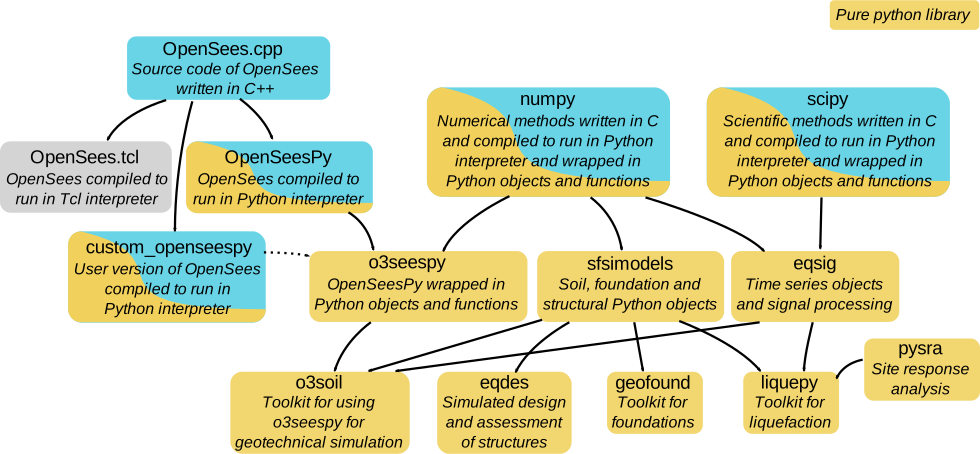
The eco-system of Python packages that relate to this package are outlined in the figure below.
Example: Dynamic inelastic SDOF analysis
import numpy as np
import matplotlib.pyplot as plt

import o3seespy as o3

from tests.conftest import TEST_DATA_DIR

# Load a ground motion
dt = 0.01
rec = np.loadtxt(TEST_DATA_DIR + 'test_motion_dt0p01.txt')

# Define inelastic SDOF
period = 1.0
xi = 0.05
mass = 1.0
f_yield = 1.5  # Reduce this to make it nonlinear
r_post = 0.0

# Initialise OpenSees instance
osi = o3.OpenSeesInstance(ndm=2, state=0)

# Establish nodes
bot_node = o3.node.Node(osi, 0, 0)
top_node = o3.node.Node(osi, 0, 0)

# Fix bottom node
o3.Fix3DOF(osi, top_node, o3.cc.FREE, o3.cc.FIXED, o3.cc.FIXED)
o3.Fix3DOF(osi, bot_node, o3.cc.FIXED, o3.cc.FIXED, o3.cc.FIXED)
# Set out-of-plane DOFs to be constrained
o3.EqualDOF(osi, top_node, bot_node, [o3.cc.Y, o3.cc.ROTZ])

# nodal mass (weight / g):
o3.Mass(osi, top_node, mass, 0., 0.)

# Define material
k_spring = 4 * np.pi ** 2 * mass / period ** 2
bilinear_mat = o3.uniaxial_material.Steel01(osi, fy=f_yield, e0=k_spring, b=r_post)

# Assign zero length element, # Note: pass actual node and material objects into element
o3.element.ZeroLength(osi, [bot_node, top_node], mats=[bilinear_mat], dirs=[o3.cc.DOF2D_X], r_flag=1)

# Define the dynamic analysis
load_tag_dynamic = 1
pattern_tag_dynamic = 1

# Define the dynamic analysis
acc_series = o3.time_series.Path(osi, dt=dt, values=-1 * rec)  # should be negative
o3.pattern.UniformExcitation(osi, dir=o3.cc.X, accel_series=acc_series)

# set damping based on first eigen mode
angular_freq = o3.get_eigen(osi, solver='fullGenLapack', n=1) ** 0.5
beta_k = 2 * xi / angular_freq
o3.rayleigh.Rayleigh(osi, alpha_m=0.0, beta_k=beta_k, beta_k_init=0.0, beta_k_comm=0.0)

# Run the dynamic analysis
o3.wipe_analysis(osi)

# Run the dynamic analysis
o3.algorithm.Newton(osi)
o3.system.SparseGeneral(osi)
o3.numberer.RCM(osi)
o3.constraints.Transformation(osi)
o3.integrator.Newmark(osi, gamma=0.5, beta=0.25)
o3.analysis.Transient(osi)

o3.test_check.EnergyIncr(osi, tol=1.0e-10, max_iter=10)
analysis_time = (len(rec) - 1) * dt
analysis_dt = 0.001
outputs = {
    "time": [],
    "rel_disp": [],
    "rel_accel": [],
    "rel_vel": [],
    "force": []
}

while o3.get_time(osi) < analysis_time:
    o3.analyze(osi, 1, analysis_dt)
    curr_time = o3.get_time(osi)
    outputs["time"].append(curr_time)
    outputs["rel_disp"].append(o3.get_node_disp(osi, top_node, o3.cc.X))
    outputs["rel_vel"].append(o3.get_node_vel(osi, top_node, o3.cc.X))
    outputs["rel_accel"].append(o3.get_node_accel(osi, top_node, o3.cc.X))
    o3.gen_reactions(osi)
    outputs["force"].append(-o3.get_node_reaction(osi, bot_node, o3.cc.X))  # Negative since diff node
o3.wipe(osi)
for item in outputs:
    outputs[item] = np.array(outputs[item])


plt.plot(outputs['time'], outputs['rel_disp'], label='o3seespy')
periods = np.array([period])

# Compare closed form elastic solution
from eqsig import sdof
resp_u, resp_v, resp_a = sdof.response_series(motion=rec, dt=dt, periods=periods, xi=xi)
plt.plot(np.arange(len(rec)) * dt, resp_u[0], ls='--', label='Elastic')
plt.legend()
plt.savefig('readme_example.png')
plt.show()