o3seespy.time_series
- class o3seespy.command.time_series.Constant(osi, factor: Optional[float] = None)[source]
Bases:
TimeSeriesBaseThe Constant TimeSeries Class
This command is used to construct a TimeSeries object in which the load factor applied remains constant and is independent of the time in the domain, i.e.
 .
.Initial method for Constant
- Parameters
osi (o3seespy.OpenSeesInstance) –
factor (float, optional) – The load factor applied
Examples
>>> import o3seespy as o3
>>> osi = o3.OpenSeesInstance(ndm=2)
>>> o3.time_series.Constant(osi, factor=1.0)
- op_type = 'Constant'
- class o3seespy.command.time_series.Linear(osi, factor: Optional[float] = None, t_start: Optional[float] = None)[source]
Bases:
TimeSeriesBaseThe Linear TimeSeries Class
This command is used to construct a TimeSeries object in which the load factor applied is linearly proportional to the time in the domain, i.e.:math:lambda = f(t) = cFactor * (t-tStart). (0 if t < tStart)
Initial method for Linear
- Parameters
osi (o3seespy.OpenSeesInstance) –
factor (float, optional) – Linear factor
t_start (float, optional) – Start time
Examples
>>> import o3seespy as o3
>>> osi = o3.OpenSeesInstance(ndm=2)
>>> o3.time_series.Linear(osi, factor=1.0)
- op_type = 'Linear'
- class o3seespy.command.time_series.Path(osi, dt: Optional[float] = None, values: Optional[list] = None, time: Optional[list] = None, file_path: Optional[str] = None, file_time: Optional[str] = None, factor: Optional[float] = None, start_time: Optional[float] = None, use_last=False, prepend_zero=False)[source]
Bases:
TimeSeriesBaseThe Path TimeSeries Class
The relationship between loadfactor and time is input by the user as a series of discrete points inthe 2d space (load factor, time). The input points can come from afile or from a list in the script. When the time specified does not matchany of the input points, linear interpolation is used between points.There are many ways to specify the load path, for example,
Initial method for Path
- Parameters
osi (o3seespy.OpenSeesInstance) –
dt (float, optional) – Time interval between specified points.
values (list, optional) – Load factor values in a |list|.
time (array_like, optional) – Time values in a |list|.
file_path (str, optional) – File containing the load factors values.
file_time (str, optional) – File containing the time values for corresponding load factors.
factor (float, optional) – A factor to multiply load factors by.
start_time (float, optional) – Provide a start time for provided load factors.
use_last (bool) – Use last value after the end of the series.
prepend_zero (bool) – Prepend a zero value to the series of load factors.
- op_type = 'Path'
- class o3seespy.command.time_series.Pulse(osi, t_start, t_end, period, width: Optional[float] = None, shift: Optional[float] = None, factor: Optional[float] = None, zero_shift: Optional[float] = None)[source]
Bases:
TimeSeriesBaseThe Pulse TimeSeries Class
This command is used to construct a TimeSeries object in which the load factor is some pulse function of the time in the domain.
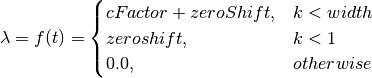

Initial method for Pulse
- Parameters
osi (o3seespy.OpenSeesInstance) –
t_start (float) – Starting time of non-zero load factor.
t_end (float) – Ending time of non-zero load factor.
period (float) – Characteristic period of pulse.
width (float, optional) – Pulse width as a fraction of the period. (optinal)
shift (float, optional) – Phase shift in seconds.
factor (float, optional) – Load factor.
zero_shift (float, optional) – Zero shift.
Examples
>>> import o3seespy as o3
>>> osi = o3.OpenSeesInstance(ndm=2)
>>> o3.time_series.Pulse(osi, t_start=1.0, t_end=1.0, period=1.0, width=0.5, shift=0.0, factor=1.0, zero_shift=0.0)
- op_type = 'Pulse'
- class o3seespy.command.time_series.Rectangular(osi, t_start, t_end, factor: Optional[float] = None)[source]
Bases:
TimeSeriesBaseThe Rectangular TimeSeries Class
This command is used to construct a TimeSeries object in which the load factor is constant for a specified period and 0 otherwise, i.e.

Initial method for Rectangular
- Parameters
osi (o3seespy.OpenSeesInstance) –
t_start (float) – Starting time of non-zero load factor.
t_end (float) – Ending time of non-zero load factor.
factor (float, optional) – Load factor.
Examples
>>> import o3seespy as o3
>>> osi = o3.OpenSeesInstance(ndm=2)
>>> o3.time_series.Rectangular(osi, t_start=1.0, t_end=1.0, factor=1.0)
- op_type = 'Rectangular'
- class o3seespy.command.time_series.TimeSeriesBase[source]
Bases:
OpenSeesObject- op_base_type = 'timeSeries'
- class o3seespy.command.time_series.Triangle(osi, t_start, t_end, period, factor: Optional[float] = None, shift: Optional[float] = None, zero_shift: Optional[float] = None)[source]
Bases:
TimeSeriesBaseThe Triangle TimeSeries Class
This command is used to construct a TimeSeries object in which the load factor is some triangular function of the time in the domain.


Initial method for Triangle
- Parameters
osi (o3seespy.OpenSeesInstance) –
t_start (float) – Starting time of non-zero load factor.
t_end (float) – Ending time of non-zero load factor.
period (float) – Characteristic period of sine wave.
factor (float, optional) – Load factor.
shift (float, optional) – Phase shift in radians.
zero_shift (float, optional) – Zero shift.
Examples
>>> import o3seespy as o3
>>> osi = o3.OpenSeesInstance(ndm=2)
>>> o3.time_series.Triangle(osi, t_start=1.0, t_end=1.0, period=1.0, factor=1.0, shift=0.0, zero_shift=0.0)
- op_type = 'Triangle'
- class o3seespy.command.time_series.Trig(osi, t_start, t_end, period, factor: Optional[float] = None, shift: Optional[float] = None, zero_shift: Optional[float] = None)[source]
Bases:
TimeSeriesBaseThe Trig TimeSeries Class
This command is used to construct a TimeSeries object in which the load factor is some trigonemtric function of the time in the domain

Initial method for Trig
- Parameters
osi (o3seespy.OpenSeesInstance) –
t_start (float) – Starting time of non-zero load factor.
t_end (float) – Ending time of non-zero load factor.
period (float) – Characteristic period of sine wave.
factor (float, optional) – Load factor.
shift (float, optional) – Phase shift in radians.
zero_shift (float, optional) – Zero shift.
Examples
>>> import o3seespy as o3
>>> osi = o3.OpenSeesInstance(ndm=2)
>>> o3.time_series.Trig(osi, t_start=1.0, t_end=1.0, period=1.0, factor=1.0, shift=0.0, zero_shift=0.0)
- op_type = 'Trig'